 Grow Guide
Overwatering vs Underwatering Cannabis: How to Identify and Fix Both
Jan
Mastering the art of watering cannabis plants is truly one of the most critical tasks in the entire home growing cannabis process. The simple act of providing water affects everything your plant does, meaning proper cannabis watering dictates your success or failure.
For many new growers, it is very easy to misdiagnose over watering and underwatering cannabis plants. In this cannabis watering grow guide, you’ll learn exactly how to identify each unique problem, clearly differentiate them, fix them using proven methods. Most importantly, we shall be looking at how to prevent them from ever happening.
What does water do to cannabis?
To appreciate why the right amount of water is so important, you must first understand the many vital roles water plays inside your plant’s system.
- Water serves as the essential transport system that carries all necessary nutrients from the growing medium up into the leaves for processing, ensuring effective
- Through the process of photosynthesis, water combines with carbon dioxide and light energy to create sugars, which are the fundamental building blocks for all growth.
- Your plants use water evaporation from the leaves, known as transpiration, to regulate their internal temperature, which is why monitoring cannabis watering temperature is key.
- Finally, the roots of your cannabis plants need access to oxygen (O₂) in the air pockets within the soil, and healthy roots are required for robust cannabis growth.
When the amount of water is unbalanced, either too much or too little, your plant immediately suffers from significant stress responses.
How do I know if I’m overwatering my cannabis plants
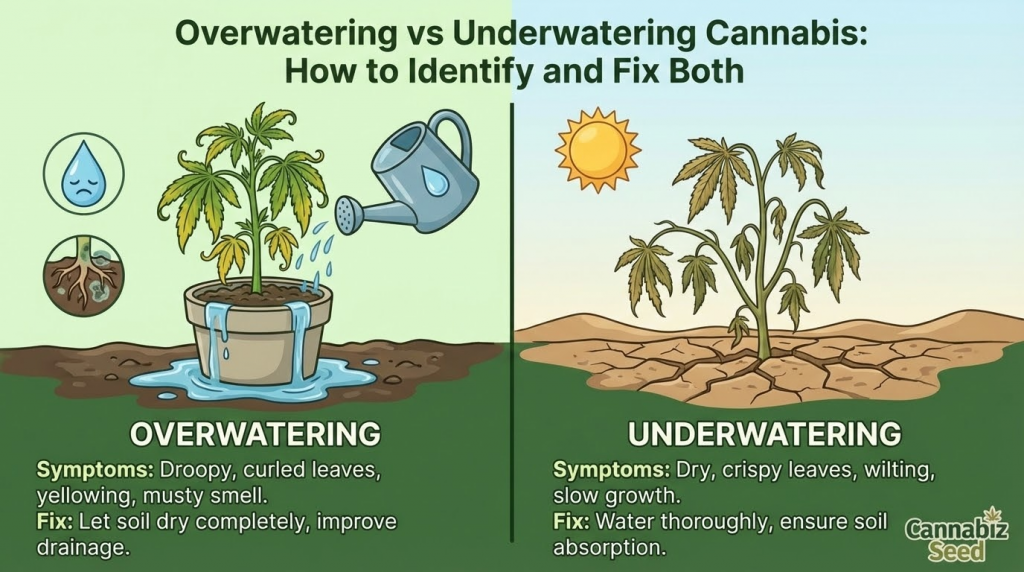
Too much water floods the medium, completely pushing out the air pockets needed by the roots. This will then lead to root oxygen deprivation while setting up a situation ripe for developing root rot signs.
Signs in the Soil & Medium
The easiest way to identify that you are over watering cannabis is by paying close attention to the conditions of your soil or growing medium. When you are suffering from cannabis over watering:
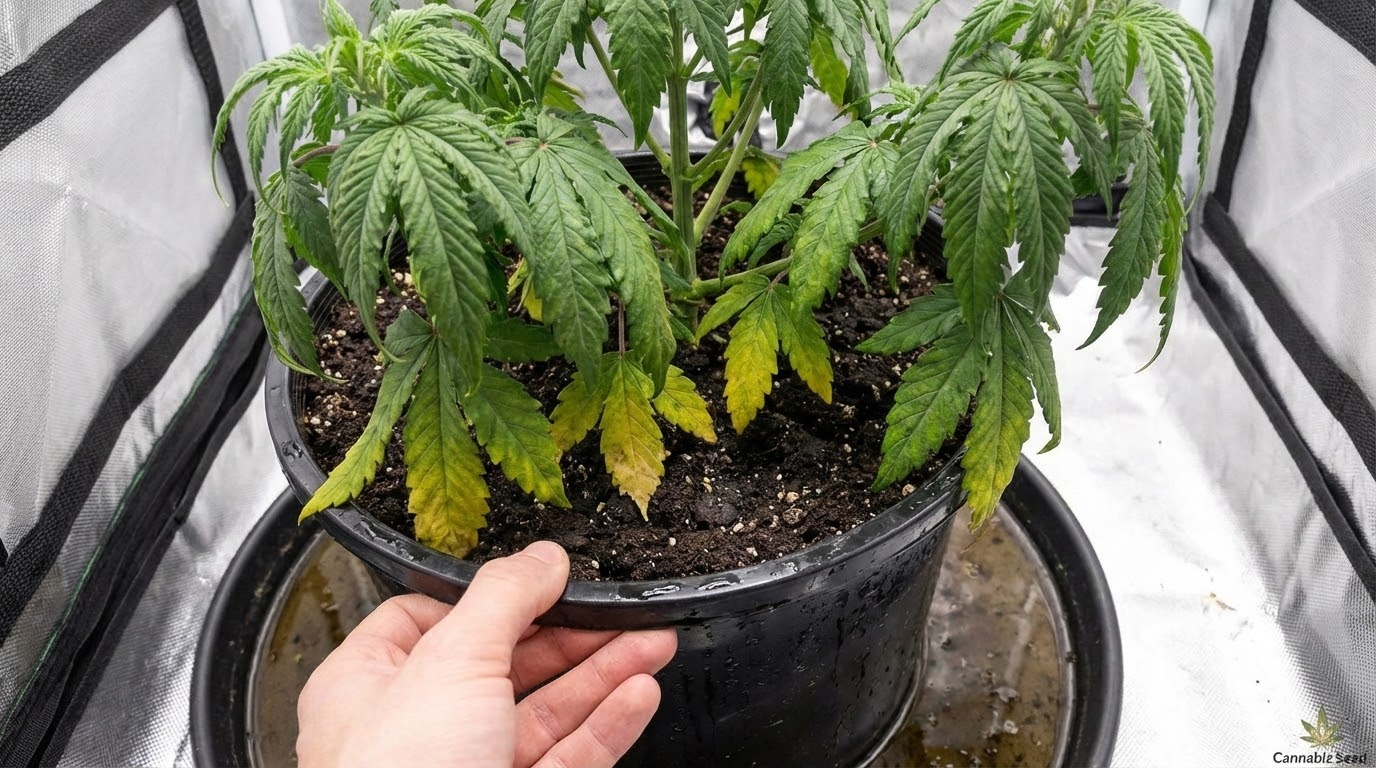
- The medium remains noticeably soggy to the touch for several days after you last watered. It will also be exceedingly slow to dry out.
- If you see water pooling on the surface or sitting in the runoff tray for hours, that is a clear indication of poor drainage and a common cannabis over watering sign.
- When you lift the container, it will feel extremely heavy compared to a properly watered pot.
- The medium itself often feels cold, suggesting the root zone is likely lacking the oxygen it desperately needs.
Visual & Physical symptoms of overwatering weed
The visual signs of over watered cannabis are often mistaken for nutrient deficiencies, but there are key differences that you can observe right away.
- The most telling symptom is that the leaves droop heavily, yet they will appear firm or water-logged, feeling swollen rather than being limp and dry to the touch.
- It is common to see the leaves curl downward dramatically at the tips in a severe condition often called “clawing,” which is a classic over watering cannabis symptom.
- Yellowing of the lower leaves often begins as the plant struggles with nutrient uptake due to damaged roots, which also leads to slow or completely stunted overall growth.
- If you are experiencing yellowing, you should immediately check your roots, as brown, soft, or foul-smelling roots are definite signs of root rot in cannabis.
Why Overwatering Happens
Understanding the cause of your cannabis over watering is the first step toward preventing it from happening again in the future.
- The most common cause is simply watering too frequently, not allowing the medium enough time to fully dry out between each session, leading to suffocation of the roots.
- Another common mistake is giving too large a volume of water during a single feeding, which saturates the soil past its holding capacity.
- Growers using a very dense or compacted medium, or those growing in an environment with high humidity and low airflow, naturally increase their risk of cannabis leaves drooping after watering.
Can cannabis plants recover from overwatering?
Yes, you can absolutely help you over watered cannabis recover, provided the root damage is not too severe, but you must act immediately.
- Your first and most critical immediate action is to stop watering completely, allowing the medium a chance to dry out significantly, potentially for several days.
- If possible, gently tilt the container to improve drainage and encourage excess water near the top of the container to exit faster.
- To increase the airflow around the pot, add a small fan to the base to help the medium dry faster.
- If you suspect severe root rot due to prolonged cannabis over watering, you should consider the drastic step of repotting the plant. Use a fresh, well-aerated medium after gently trimming away any brown, soft, rotted roots.
- For long-term corrections, consider adding perlite or vermiculite to the soil to improve medium amendments and increase aeration.
- Use fabric pots, which allow for better oxygen exchange and natural drying, before immediately correcting your watering schedule for cannabis.
What does underwatering cannabis look like
Too little water causes dehydration, forcing the plant into a survival mode.
Signs in the Soil & Medium
Identifying underwatering cannabis is often simpler than diagnosing an overwatering issue because the signs in the medium are obvious and easy to spot.
The soil will be clearly very dry, feeling rock-hard and possibly pulling noticeably away from the inner walls of the pot, making the container feel extremely light to lift. When the medium is this dry, it can become hydrophobic, meaning water runs straight through it without soaking in.
The container will feel feather-light when you lift it, which is a clear indicator that there is no remaining moisture left in the root zone. In addition, your underwatered cannabis growing medium may actually appear cracked on the surface.
Visual & Physical Plant Symptoms
You will notice that the leaves droop heavily, just like in overwatering. To differentiate the two, the leaves feel thin, dry, and brittle, unlike the firm, turgid leaves of an overwatered plant.

Pro Grow Tip : Many growers check the pot for heaviness to see if there is enough water. As well you can follow the rule of watering only when the top 2 – 5 cm is dry.
The plant will lose its natural healthy sheen and turgidity, and you may notice the edges of the leaves beginning to turn brown or crispy if the dehydration is severe and prolonged.
The midday heat, when transpiration is at its highest, makes your cannabis plant wilted.
Why Underwatering Happens
The reasons why you might experience under watering cannabis are often related to neglect or miscalculation of the plant’s true needs.
- The most common cause is leaving too long a time between watering sessions. This allows the soil to become bone dry, especially in a fast-draining medium like cannabis coco coir watering schedule setups.
- Using a container that is too small for the plant’s current size can lead to a root-bound condition where the roots quickly suck up all available moisture.
- Additionally, growing in an environment with extremely high temperatures or low humidity causes rapid water loss through evaporation and transpiration. Without proper adjustments of your cannabis watering schedule, underwatering sets in.
Factors That Affect Watering
Grow room conditions and environment
Your environment plays a massive role in dictating your plant’s water needs, so you must adapt your cannabis watering.
- Higher temperatures naturally increase the rate of transpiration, which means your plant’s water demand will be significantly higher and more frequent.
- Low humidity causes the medium to dry faster, while high humidity slows down medium drying, creating a higher risk for cannabis over watering if you don’t adjust.
- Stronger light intensity also results in higher water demand as the plant is working harder to perform photosynthesis.
Growth Stages
Water demands change dramatically as the plant moves through its life cycle, requiring you to adjust frequently.
- Seedlings: They have a very small root zone, so they need shallow watering concentrated near the stem, making the risk of overwatering cannabis seedlings extremely high.
- Vegetative: This is a period of rapid growth, which results in dramatically increased water demand as the plant builds structure.
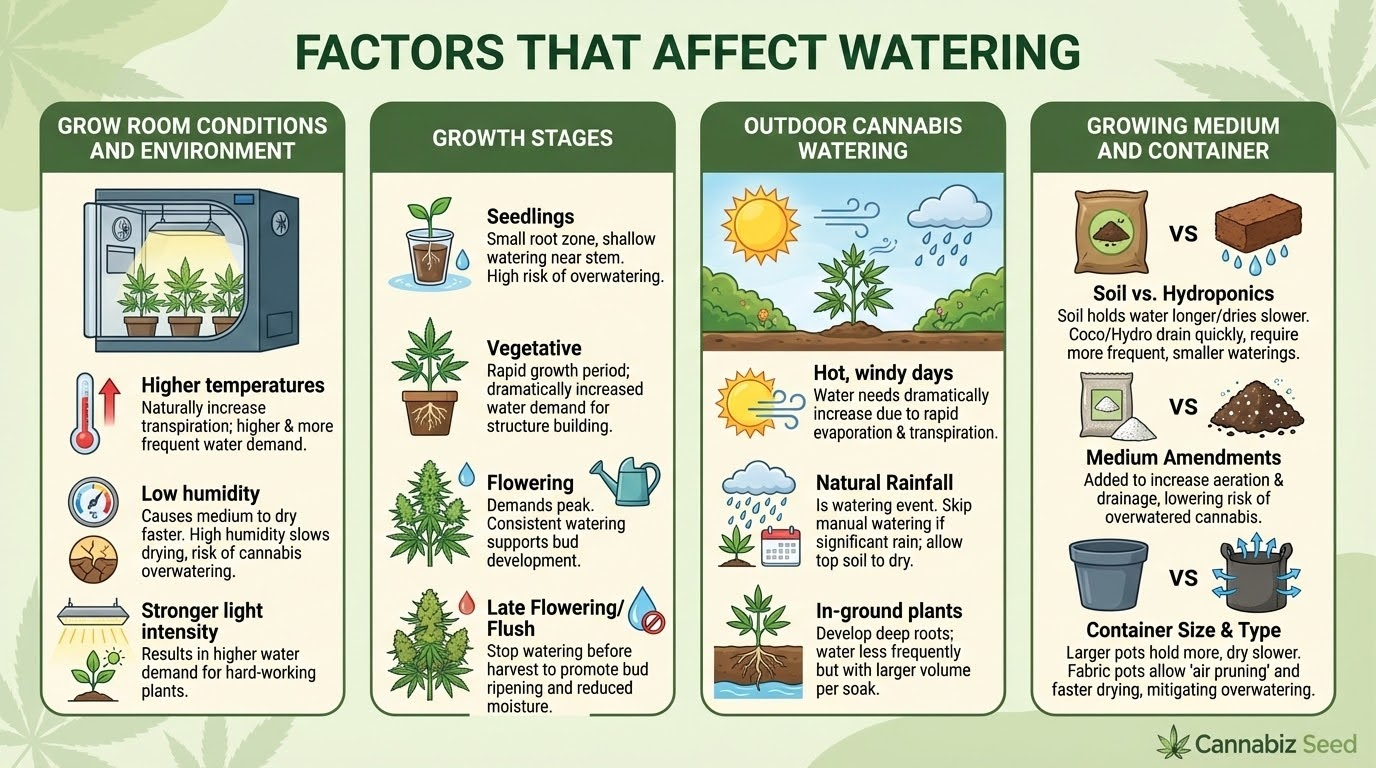
- Flowering: Demands peak here. Consistent watering during flowering keeps the root zone healthy enough to support bud development.
- Late Flowering/Flush: Why do you stop watering cannabis before harvest? you promote bud ripening and reduced moisture. This aids in reduced bud moisture before harvest
Outdoor cannabis watering
How often do you water your outdoor cannabis? When you move your grow outdoors, you forfeit the control of an indoor environment.
- Your watering needs will dramatically increase on hot, windy days because the sun and air currents rapidly accelerate both the soil’s surface evaporation and the plant’s transpiration rate.
- Is rain good for outdoor cannabis? Yes, natural rainfall is a watering event. If you receive significant rain, be sure to skip your manual watering session for a few days until the top soil dries out.
- Cannabis plants planted directly in the ground develop deep and resilient root systems that can search for deep groundwater. You will usually water them less frequently but with a much larger volume during each soak.
Growing Medium and Container
The type of medium you choose fundamentally affects how often you need to apply water.
- Soil holds water longer and dries slower, thus requiring less frequent watering than hydroponics.
- Coco/Hydro mediums drain quickly and have more airspace. They often require more frequent, smaller waterings.
- Medium amendments like perlite, vermiculite, and coco coir are added specifically to increase aeration and drainage, which directly lowers the risk of over watered cannabis issues.
Your container size and type also matter greatly. Larger pots naturally hold more water and dry slower, while fabric pots allow the sides of the medium to “air prune” the roots. This helps them dry much faster than plastic pots, mitigating the risk of cannabis over watering.
Water Quality, pH & Nutrient Considerations
While how much you water matters, the actual quality of your water plays an equally massive role in root health and nutrient uptake. If the water hardness is way off, you risk killing the beneficial microbes and stressing out those fragile cannabis roots.
Another dealbreaker is pH balance. Get this wrong, and you trigger nutrient lockout, which basically starves the plant regardless of how much fertilizer you dump in. For hydro or coco coir, aim for a pH of 5.5 to 6.5. If you are growing in soil, keep that number between 6.0 and 7.0.
Preventative Practices & Best Habits
The key to a successful grow is moving beyond reacting to problems and instead adopting a proactive approach to your cannabis watering habits.
- Make a daily check on your plant, feeling the top inch of the soil for moisture. For potted plants, you can try lifting the pot to monitor the weight before deciding to water.
- You should never follow a fixed cannabis watering schedule. Instead, water only when the top inch of soil is dry.
- Always use pots with appropriate size and excellent drainage holes, and adjust your medium selection to one that matches your growing style.
- Match your container choice to the specific grow setup, whether indoor or outdoor, while watching airflow and humidity to help the medium dry.

- Hand watering is the most important skill for a home grower to learn, even if huge gardens sometimes use drip systems or cycle watering.
- Pour enough water to soak the medium completely for deep watering until you see runoff drain out.
- Write down watering volumes, dates, and environmental conditions in your grow records to fix your technique later.
FAQs
My cannabis always drops after watering?
This is almost certainly an immediate sign of overwatering. The droop is caused by a lack of oxygen in the root zone, a condition called root asphyxiation.
Is weekly watering enough for flowering plants?
No, weekly watering is generally not enough for a mature, rapidly growing cannabis flowering plant. The metabolic demands are much higher, requiring a more frequent cannabis flowering stage watering schedule.
How do I test my water quality for cannabis grow?
The simplest way to check is to use a basic pH test kit to ensure your pH is in the correct range. You can also use a TDS (Total Dissolved Solids) meter to measure the PPM (parts per million) of unwanted salts or chlorine.
What happens if you use tap water instead of distilled water?
Tap water is usually acceptable if its pH is within range and you let it sit out for 24 hours to allow chlorine to evaporate. Distilled water often lacks the necessary trace minerals that your cannabis plants need.
What time of day is best to water cannabis?
The best time of day to water is in the morning. This allows the plant to access moisture during the peak light period and reduces the risk of moisture sitting on the leaves overnight.